

Frontline Signals: Non-Verbal Communication for Hospitality and Retail Excellence
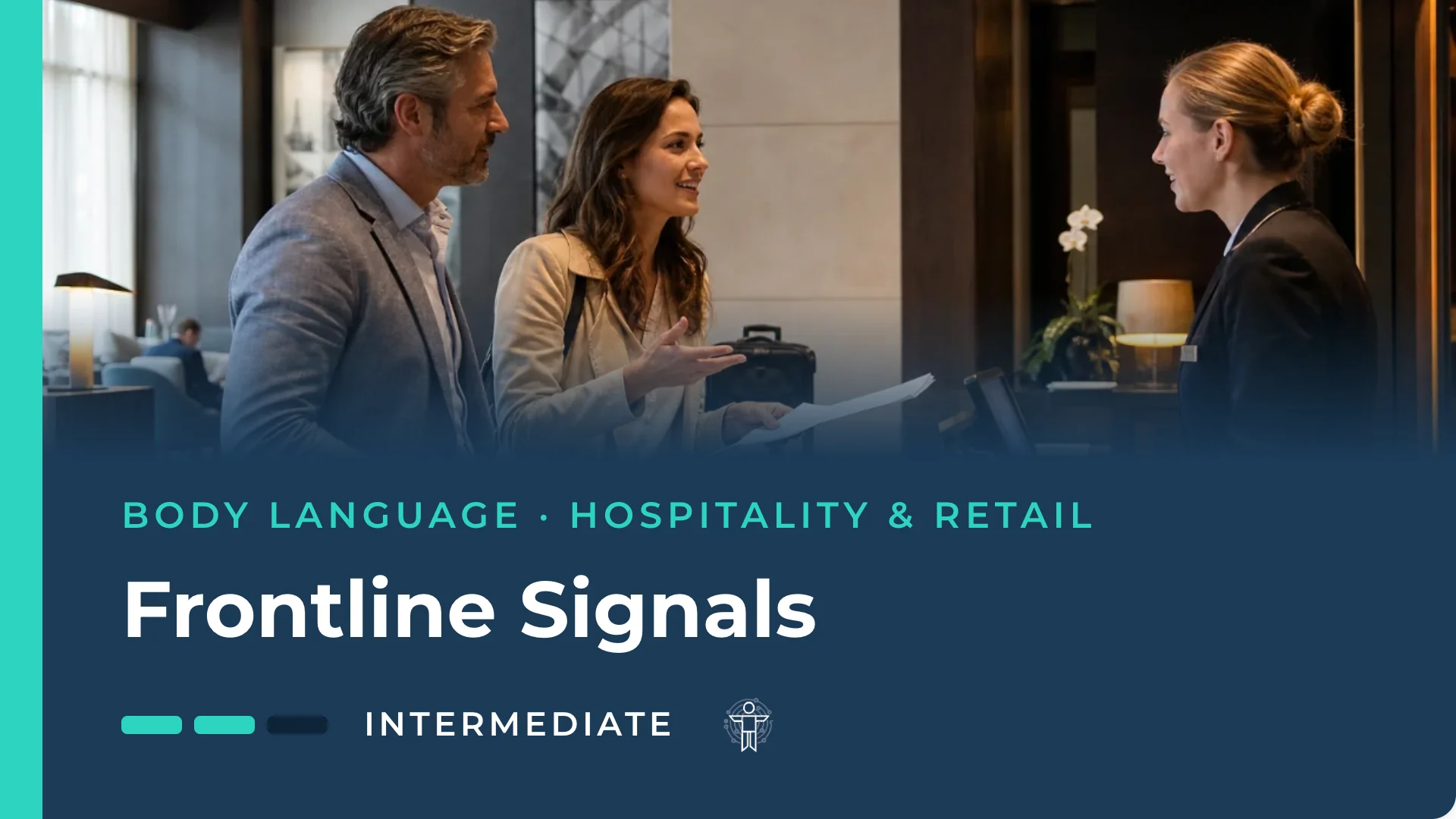
Build a reliable, ethical system for reading and shaping frontline interactions across hotels, restaurants, boutiques and supermarkets. Progress from silent welcomes and rapid observation to queue leadership, discreet service, de-escalation and commercially useful timing—without treating body language as mind reading or a lie detector.
Choose how much support you want
Same price on this course as every other. The only decision here is the level of guidance.
self-paced in the Academy live with a trainer
Self study
ACADEMYLearn the method at your own pace, on any device.
- All video lessons and materials
- Self-paced, any device
- Exercises + downloadable tools and checklists
- Community access
- AI tutor
- Completion certificate
Cohort
ACADEMYLIVELearn the method, then practise it live with a small group.
- Everything in Self study
- 4 live online group sessions (60 min)
- Guided practice for this course
- AI tutor
- 60-day session recordings
- Guided tasks between sessions
- Small group — max 15
VIP
ACADEMYLIVEPractise it live — private coaching on your real situations.
- Everything in Cohort
- Unlimited live group sessions (60 min)
- 3 private 1:1 sessions with the founder
- Personalised feedback on your real situations
- Priority support
- Personalised action plan
Secure checkout powered by Stripe. Buying for a team of 5 or more? See team pricing
Continuing Professional Development
CPD certified by Open CPD
- Self Study
- 8 CPD hours
- Cohort — adds 4 live sessions
- 12 CPD hours
Open CPD Reg. ID 620113 · Self Study figure is our own estimate
How our CPD works →What you’ll cover
- →Module 1: Establishing the Silent Welcome
- →Module 2: Baseline Before the Rapid Read
- →Module 3: Timing the Approach Window
- →Module 4: Conducting the Floor
- →Module 5: Reading Purchase and Upsell Readiness
- →Module 6: Handling the Soft No
- →Module 7: Protecting Discretion and Privacy
- →Module 8: De-escalating Complaints Without Words
- →Module 9: Reading the Exit and Farewell
- →Module 10: Managing Queues, Crowds and Pressure
What this course does not claim
Body-language marketing is full of myths. Here is what we deliberately won’t tell you.
- That one gesture “means” one thing, or reveals a lie.
- That you’ll read minds or “detect deception instantly”.
- Any “% of communication is non-verbal” figure.
What you get instead: baseline-and-cluster observation, read in context — noticing more and guessing less.
Course Curriculum
0Welcome to BodyLytics
Your guided introduction to the BodyLytics learning platform — discover interactive features, track your progress, and get the most out of your learning journey.
1.0Recognise the Arrival Signal SetPreview
Learn to observe the arrival moment with discipline: describe what you can actually see before assigning meaning. Using a rainy-evening arrival at a fictional Copenhagen hotel, you will examine posture, hands, gaze, facial expression, orientation and distance while accounting for baseline, culture and context.
1.1Practise a Grounded Welcome Stance
Rehearse the visible behaviours that make an arrival feel warm, professional and non-pressuring. You will practise posture, hand visibility, gaze, facial congruence and respectful distance while separating observable signals from assumptions about a guest.
1.2Calibrate Facial Warmth Honestly
Learn to distinguish deliberate, neutral and genuinely engaged facial warmth in hospitality and retail settings. You will practise observing facial congruence without assuming that a smile proves friendliness, honesty or readiness to engage.
1.3Position the First Contact
Integrate observation, proxemics, posture, gaze, facial congruence and gesture analysis to position a professional welcome in a busy European retail environment. You will apply the complete silent-welcome framework to a fictional Helsinki supermarket, adapting your distance and orientation without confusing cultural variation or visible discomfort with certainty about intent.
1.4Module Test: Silent Welcome
This practical assessment brings together the Module 2 skills: observing a guest's baseline, recognising meaningful deviations, choosing a calibrated stance and distance, and opening an interaction without overclaiming certainty. You will be assessed on how well you separate what you can see from what you merely suspect, especially in culturally varied European hospitality and retail settings.
2.0Describe Baseline and Deviation
Learn to establish a neutral, situational baseline before interpreting any change in behaviour. Using a fictional shopper in a Milan electronics store, you will practise observing clusters, context, and deviations without labelling personality, honesty, or intent.
2.1Map Comfort, Discomfort and Cognitive Load
Practise separating what you can observe from what you merely infer. Using a multilingual hotel check-in in Brussels, you will compare fatigue, language-processing demand and situational discomfort without labelling the guest’s personality, honesty or intent.
2.2Spot Pacifying Behaviour Without Overclaiming
In a busy retail interaction, a customer may rub their forehead, touch their neck, compress their lips or exhale after a stressful event. These behaviours can help you locate discomfort, but they do not prove deception, hostility or intent. In this activity lesson, you will practise observing the cue, linking it to a plausible trigger, and responding without turning an observation into a label.
2.3Use the First-Minute Observation Grid
This integration lesson brings together the module’s central discipline: observe first, compare against a situational baseline, identify meaningful changes, and delay interpretation until you have context. You will work through a fictional Rotterdam conference-hotel arrival scene, using a timed observation grid to distinguish what is visible from what you merely suspect.
2.4Module Test: Baseline and Rapid Read
This assessment consolidates the module’s central discipline: establish what is normal in the situation, notice meaningful deviations, generate more than one plausible explanation, and respond proportionately. You will be assessed on observation rather than personality labelling, comfort–discomfort analysis, cluster-and-context reasoning, and practical service judgement in hospitality and retail settings.
3.0Identify Approach and Space Signals
Learn to distinguish active help-seeking, deliberation, and preference for space by observing orientation, gaze, product handling, pace, and self-directed activity before you approach. Using a Prague department-store scenario, you will practise treating non-verbal cues as probabilities that guide respectful timing—not as definitive evidence of what a customer thinks.
3.1Practise the Permission-Based Approach
Rehearse how to approach a guest without turning attention into pressure. You will practise using distance, an angled entry, a brief offer and an easy decline while treating every non-verbal cue as contextual evidence rather than a definitive answer.
3.2Match Language Modality Without Stereotyping
In a Brussels camera shop, the words a customer chooses can offer clues about how they are currently processing a decision: “show me,” “sounds right,” “feels too heavy,” or “I’ll compare it online.” You will practise responding to those momentary preferences without labelling the person as a fixed “visual,” “auditory,” or “kinaesthetic” type. The goal is flexible service: listen for the customer’s language, test your interpretation, and preserve their autonomy.
3.3Run a Three-Customer Timing Drill
In this integration lesson, you will bring together baseline observation, comfort–discomfort analysis, proxemics, approach timing, perceptual positions and respectful boundary-setting. You will work through three contrasting customers at a fictional Edinburgh-style travel retail kiosk in Amsterdam station, deciding whether to approach, wait or return while documenting context and alternative interpretations.
3.4Module Test: Approach Window
This capstone assessment tests whether you can translate observation into respectful timing. You will assess three frontline situations, distinguish active help-seeking from deliberation and space preference, and choose interventions that preserve customer autonomy rather than forcing engagement. The assessment combines scenario reasoning, classification, language precision and a practical role-play.
4.0Apply Spatial Choreography
Learn how routes, sightlines, barriers, furniture and staff location shape perceived access, attention and autonomy. Using Hall’s proxemics framework and a fictional Tallinn supermarket self-checkout zone, you will redesign a service path without treating spatial cues as universal or infallible.
4.1Arrange Cooperative Service Positions
Practise using corner, angled and side-by-side positions to make hospitality interactions feel collaborative rather than confrontational. You will apply seating and body-pointing principles to a Lisbon restaurant scenario while accounting for table shape, available space, cultural expectations and the customer’s observable response.
4.2Use Gaze and Objects as Invitations
In a jewellery consultation, the difference between guidance and pressure may be no more than a glance, a hand position or where you place a ring tray. In this activity lesson, you will practise coordinating gaze, object placement, seating and open-hand gestures so customers can engage at their own pace. You will work through a fictional Antwerp consultation and learn to treat non-verbal cues as observations to test—not conclusions to impose.
4.3Choreograph a Complete Floor Handoff
In a busy service environment, attention is transferred through more than words. Your movement, gaze, seating choices, body angle and the objects you place in front of a guest all help determine who feels welcomed, who feels ignored and who retains control. This integration lesson brings together the module’s positioning, proxemics, gaze, object choreography and seating principles in a realistic Kraków hotel breakfast-room scenario.
4.4Module Test: Floor Choreography
This assessment brings together the module’s core skills: staff positioning, gaze, objects, seating, sightlines and customer autonomy. You will interpret realistic floor situations, distinguish observation from inference, and design a practical floor map that solves a sightline, seating and handoff problem without treating body language as a fixed code. The assessment is grounded in seating research, proxemics, contextual observation and cautious application across European hospitality and retail settings.
5.0Recognise Decision-Stage Behaviour
Learn to distinguish exploration, comparison, decision readiness and genuine engagement in a hospitality or retail interaction. Using a fictional shopper comparing coffee machines in a Utrecht homewares store, you will practise reading clusters and context without treating any single gesture as proof of purchase intent.
5.1Practise a Relevance-First Recommendation
In this practice lesson, you will rehearse a complete, low-pressure recommendation sequence: observe the guest’s readiness, approach during an appropriate window, ask one diagnostic question, and offer one recommendation that fits the guest’s stated or observable needs. The scenario takes place at a fictional Stockholm airport hotel, where you will recommend a room upgrade to Henrik without manufacturing urgency or treating a single gesture as proof of purchase intent.
5.2Interpret Positive Expectancy in Context
In this activity lesson, you will examine palm rubbing and related hand gestures as possible signs of positive expectancy—without turning one movement into a purchase prediction. You will practise separating a behavioural observation from an interpretation, then combine gesture, timing, context and alternatives to decide whether a guest may welcome a recommendation.
5.3Conduct an Ethical Upsell Simulation
Integrate observation, context, cluster analysis, calibrated questioning and ethical recommendation in a realistic Valencia supermarket wine-counter scenario. You will practise distinguishing browsing, comparison, decision readiness and genuine engagement without treating any single gesture as proof of purchase intent or using pressure to manufacture urgency.
5.4Module Test: Purchase and Upsell Signals
This assessment brings together the module’s central skill: recognising exploration, comparison, decision readiness and genuine engagement without turning a single gesture into a sales prediction. You will analyse realistic hospitality and retail situations, distinguish observation from interpretation, and choose customer-led responses that preserve autonomy. The assessment includes an advanced scenario quiz, matching, fill-in-the-blanks and a classification challenge. Passing requires you to reason from clusters, context and sequence—not from isolated “buying signals.”
6.0Differentiate Refusal from Deliberation
Learn to distinguish a polite refusal from a customer who is still deciding, overloaded, or managing competing demands. Using cluster-and-context analysis, you will examine orientation, answer length, object shielding, foot direction, and closed materials without turning one cue into an overconfident conclusion.
6.1Practise the Graceful Release
In a boutique, restaurant, or hotel lobby, a customer’s soft no rarely arrives as a blunt refusal. It may appear as a turn-away, a shortened reply, a hand returning to the product, or attention shifting back to the environment. In this practice lesson, you will rehearse how to acknowledge the signal, create physical space, and leave a clear path back into the interaction without making the customer defend their choice.
6.2Reduce Cognitive Load During Service
Learn to recognise when a traveller may be overloaded, simplify the interaction, and offer a clear next step without diagnosing the cause. You will practise pacing, sensory language, and respectful resets with Jonas, a fictional traveller in a multilingual Zurich rail-station shop.
6.3Recover a Missed Refusal
This integration lesson brings together calibrated approach, baseline observation, cluster-and-context analysis, personal space, rapport, and respectful disengagement. You will practise recognising when helpful service has become intrusive, apologising without making the guest manage your discomfort, and restoring autonomy in a busy Berlin hotel lobby.
6.4Module Test: The Soft No
This assessment brings together the module’s core skill: recognising polite refusal, hesitation and overload before a customer has to state them bluntly. You will apply observation-before-interpretation, distinguish a temporary state from a stable preference, and choose whether to withdraw, clarify or return later without creating embarrassment or pressure.
7.0Identify Privacy-Seeking Behaviour
Learn to recognise observable signals that a guest may need discretion, while separating privacy needs from fatigue, cognitive load, cultural communication styles and ordinary task focus. Using a Geneva hotel-desk scenario, you will practise observation before interpretation and select responses that protect autonomy, safety and consent.
7.1Create a Discreet Service Channel
Practise recognising when a customer may want greater privacy and offering a quieter, lower-exposure service route without forcing disclosure. You will apply spatial positioning, voice control, written options, colleague handoff and respectful uncertainty in a Copenhagen pharmacy-style beauty retail scenario.
7.2Use Objects and Positioning to Protect Dignity
Practise using objects, surfaces, staff positioning and calibrated distance to protect a guest’s privacy during a sensitive service interaction. In a Warsaw hotel lobby lost-property scenario, you will reduce unnecessary exposure without inferring private facts, compromising safety or creating operational confusion.
7.3Design a Privacy Response Protocol
Integrate observation, consent, spatial awareness, discreet service choreography, documentation and escalation into one practical privacy protocol. You will apply the protocol to a fictional restaurant scenario in Nice, while distinguishing observable signals from assumptions about a guest’s personal life, health or intentions.
7.4Module Test: Discretion Moments
This assessment brings together the privacy, consent, spatial protection and referral skills developed in Module 8. You will analyse realistic hospitality and retail situations, distinguish observable signals from speculation, and choose responses that protect autonomy without abandoning safety. To pass, demonstrate that you can manage a privacy-sensitive interaction through appropriate positioning, voice, choreography, consent-based language and professional boundaries.
8.0Recognise Escalation and Pacification Cycles
Learn to observe how stress appears, intensifies and settles during frontline complaints. Using a fictional minibar dispute at a Ljubljana hotel, you will distinguish freezing, withdrawal, jaw tension, lip compression and self-touch from assumptions about guilt or intent—and practise responding in ways that reduce threat and cognitive load.
8.1Practise the Non-Threatening Stance
Learn to reduce pressure during a queue-side complaint by using body angle, visible hands, clear exits, measured movement and well-timed silence.
8.2Control Tempo and Questioning
In a complaint, the quality of your questions is only part of the interaction. Your pace, pauses, gaze and physical orientation can either reduce cognitive load or make a distressed customer feel interrogated. In this activity lesson, you will investigate a fictional delivery error with Roberto, a customer at a Madrid restaurant, while practising one-question-at-a-time interviewing without treating discomfort as proof of culpability.
8.3Run a Silent De-escalation Rehearsal
In this integration lesson, you will combine observation, spatial positioning, pacing, gaze, turn-taking and concise service-recovery language in one realistic complaint scenario. You will first rehearse a response without words, then add language and compare how each version affects threat, cognitive load and customer autonomy. The focus is not detecting guilt; it is reducing friction while gathering enough information to repair the service failure responsibly.
8.4Module Test: Complaints and De-escalation
This assessment brings together the module’s core skills: observing complaint behaviour without overinterpreting it, reducing perceived threat through stance and distance, lowering cognitive load through pace and sequencing, and using turn-taking signals to restore a workable conversation. You will be assessed on both what you notice and how responsibly you respond. The central standard is not whether you can “read” a customer with certainty, but whether you can make a safer, clearer and more respectful next move.
9.0Observe the Exit Read
Learn to treat departure behaviour as feedback about the interaction that has just occurred. You will examine pace, orientation, farewell engagement, object handling and companion dynamics while avoiding the common mistake of turning one exit cue into a confident prediction about future loyalty.
9.1Practise Congruent Farewells
Rehearse how to close a customer interaction without adding pressure at the moment of departure. In a Rotterdam bookshop scenario, practise matching your farewell to available attention, noticing unresolved friction, and using space, timing, and concise acknowledgement to leave the interaction open and respectful.
9.2Separate Friction from Ordinary Urgency
Learn to distinguish a genuinely time-pressured departure from a quiet withdrawal or an unresolved service problem. Using a fictional restaurant in Naples, you will combine posture, pacing, orientation, objects and conversation context before choosing a respectful response.
9.3Build a Feedback-Triggered Follow-Up
Integrate baseline observation, behavioural clusters, proxemics, rapport, cultural context and service recovery into one respectful follow-up decision using a Dublin hotel departure scenario.
9.4Module Test: Exit Read
This capstone assessment evaluates whether you can read departures as feedback about the interaction that has just occurred—not as proof of future loyalty or disloyalty. You will analyse three realistic hospitality and retail exits, distinguish observation from interpretation, and choose farewell and follow-up actions that protect customer autonomy while addressing unresolved friction. The assessment draws on baseline observation, clusters, context, proxemics, congruent warmth, and ethical follow-up.
10.0Map Crowd and Queue States
Learn to read a queue as a changing social system rather than a collection of isolated customers. You will identify compression, scanning, subgroup formation, repeated checking, blocked movement, and leader–follower patterns while separating observable behaviour from interpretation. The lesson applies the full BodyLytics method to a payment-system delay in a fictional Brussels supermarket.
10.1Practise Visible Queue Leadership
In this practice lesson, you will lead a high-pressure breakfast queue at a fictional Oslo hotel during conference departure. You will apply the full observation method: establish a baseline, notice clustered deviations, make your availability visible, and intervene proportionately through orientation, sightlines, movement and distributed gaze.
10.2Coordinate Staff and Objects Under Pressure
In a seasonal rush, customers do not experience a queue as a neutral line. They experience uncertainty: where to stand, who is next, whether their problem has been noticed, and whether the team is coping. In this activity lesson, you will choreograph people, barriers, signs, counters and handoffs at a fictional Barcelona department-store returns desk while monitoring individual overload without over-interpreting a single gesture.
10.3Capstone Integration: Run the Frontline Lifecycle
Bring the module’s complete method into one realistic European hospitality scenario. You will move from first observation to proportionate action, integrating baseline reading, clustered deviations, proxemics, approach timing, recommendations, soft refusals, privacy, complaint recovery and queue control without treating any single gesture as proof of intent.
10.4Module Test: Queues, Crowds and Full Lifecycle
This demanding assessment integrates the complete BodyLytics method across a realistic frontline pressure event. You will be assessed on observation, baseline awareness, clustered deviations, context-sensitive interpretation, proportionate intervention, coordinated team signalling, privacy protection and evidence-based debriefing. The scenarios draw on hospitality, retail and aviation-style service environments, where visible control and reduced uncertainty often matter as much as the eventual verbal solution.
11.0Final Exam: Frontline Non-Verbal Communication Practicum
This comprehensive practicum evaluates whether you can observe, interpret and respond to non-verbal signals across the full hospitality and retail interaction lifecycle. You will work through novel European scenarios involving arrival, approach, purchase readiness, refusal, privacy, complaint handling, queue pressure and service recovery. The assessment rewards disciplined observation, calibrated action and ethical reasoning—not confident guesses about what another person is thinking.
11.1Course Evaluation
Reflect on what you have learned, consolidate the course framework, and share feedback that will help improve Frontline Signals for hospitality and retail professionals.