

Body Language Master Class: Advanced Non-Verbal Intelligence for High-Stakes Practitioners
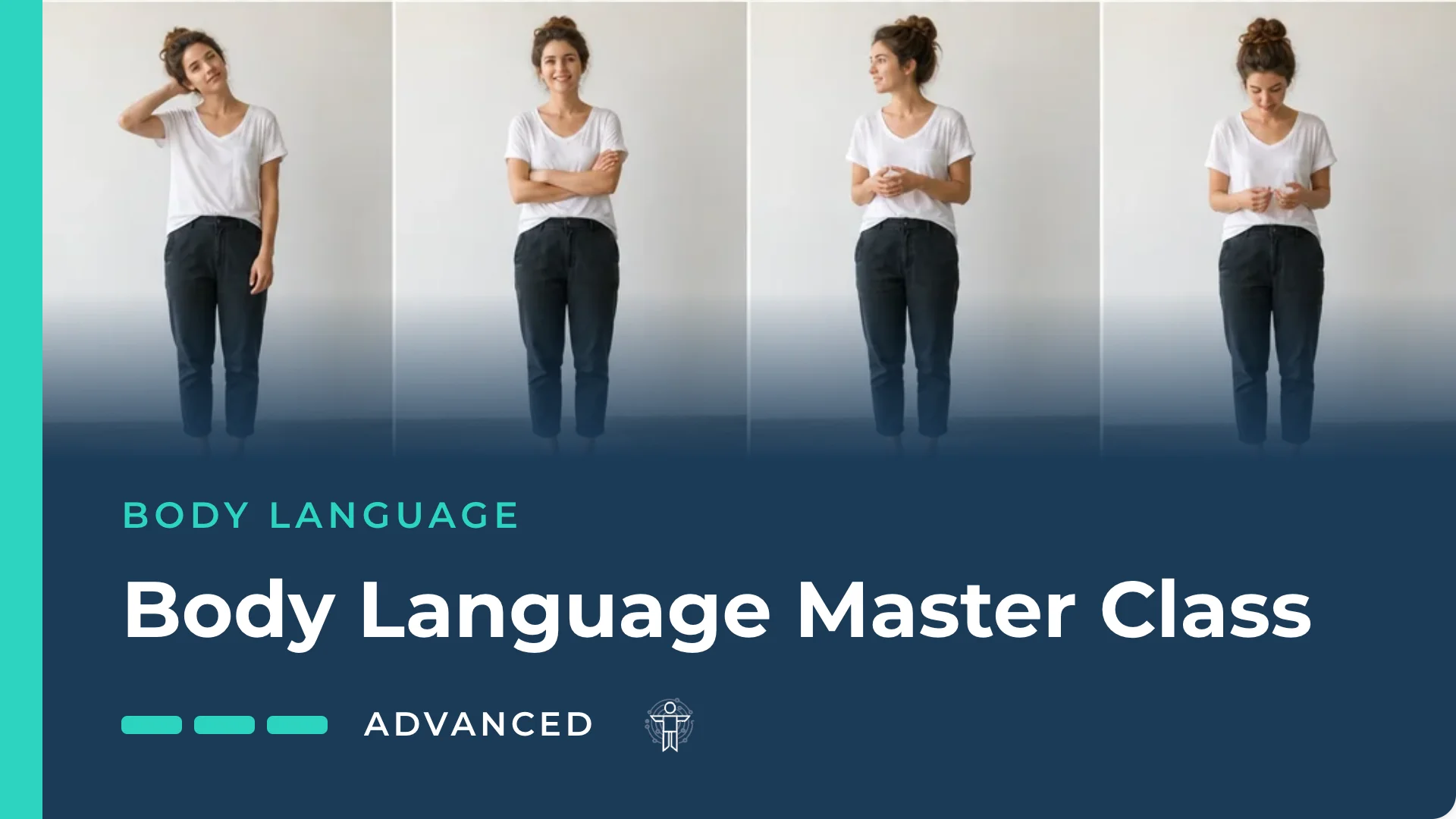
A rigorous flagship programme for consultants, senior sales professionals, negotiators and leaders who want to move from noticing isolated cues to making disciplined, context-aware observations in real time. Through baselining, cluster analysis, stress and cognitive-load detection, group dynamics, cross-cultural calibration and ethical self-audit, learners build confident practice without treating body language as mind reading or a lie detector.
Choose how much support you want
Same price on this course as every other. The only decision here is the level of guidance.
self-paced in the Academy live with a trainer
Self study
ACADEMYLearn the method at your own pace, on any device.
- All video lessons and materials
- Self-paced, any device
- Exercises + downloadable tools and checklists
- Community access
- AI tutor
- Completion certificate
Cohort
ACADEMYLIVELearn the method, then practise it live with a small group.
- Everything in Self study
- 4 live online group sessions (60 min)
- Guided practice for this course
- AI tutor
- 60-day session recordings
- Guided tasks between sessions
- Small group — max 15
VIP
ACADEMYLIVEPractise it live — private coaching on your real situations.
- Everything in Cohort
- Unlimited live group sessions (60 min)
- 3 private 1:1 sessions with the founder
- Personalised feedback on your real situations
- Priority support
- Personalised action plan
Secure checkout powered by Stripe. Buying for a team of 5 or more? See team pricing
Continuing Professional Development
CPD certified by Open CPD
- Self Study
- 8.5 CPD hours
- Cohort — adds 4 live sessions
- 12.5 CPD hours
Open CPD Reg. ID 620113 · Self Study figure is our own estimate
How our CPD works →What you’ll cover
- →Baseline Under Time Pressure
- →Cluster Analysis and Confidence Weighting
- →Deception, Leakage and Its Limits
- →Cognitive Load and Stress in Real Time
- →High-Stakes Reads in Negotiations and Boardrooms
- →Group Dynamics, Coalitions and Dissent
- →Cross-Cultural Calibration Across Europe and Beyond
- →The Practitioner's Discipline and Ethical Self-Audit
- →Capstone: From Observation to Strategic Communication
What this course does not claim
Body-language marketing is full of myths. Here is what we deliberately won’t tell you.
- That one gesture “means” one thing, or reveals a lie.
- That you’ll read minds or “detect deception instantly”.
- Any “% of communication is non-verbal” figure.
What you get instead: baseline-and-cluster observation, read in context — noticing more and guessing less.
Course Curriculum
0Welcome to BodyLytics
Your guided introduction to the BodyLytics learning platform — discover interactive features, track your progress, and get the most out of your learning journey.
1.0Define the Observation-to-Decision SequencePreview
In high-stakes professional settings, disciplined observation is not mind reading. This lesson gives you a repeatable sequence for moving from visible behaviour to a proportionate, ethical decision while preserving uncertainty, cultural context and the possibility of alternative explanations.
1.1Build a Three-Minute Baseline
Before a high-stakes conversation begins, the most valuable information may come from the minutes when nobody is negotiating yet. In this practice lesson, you will calibrate yourself to a German engineering supplier’s ordinary behaviour during informal introductions, then record observable changes without converting them prematurely into claims about attitude, credibility or truthfulness.
1.2Separate Deviation From Personal Style
In high-stakes observation, difference is not automatically significance. This activity lesson places you inside a Milan design consultancy where two professionals display markedly different natural styles: one gestures rapidly and expansively, while the other remains still and economical. You will practise separating stable personal style from stimulus-linked deviation, recording observations before interpretation, and choosing proportionate verbal follow-up.
1.3Run a Fast Calibration Drill
This integration lesson brings together the observation disciplines from Module 2: establish a provisional baseline, detect meaningful deviation, separate observation from interpretation, and test alternative explanations before intervening. You will work through a time-pressured hybrid-meeting scenario involving a Danish client team, then evaluate your own calibration habits and practise rapid recall of the module’s key terms.
1.4Module Test: Baseline Under Time Pressure
This capstone assessment asks you to apply the complete baseline-and-deviation protocol in a simulated European supplier review. You will observe before interpreting, distinguish ordinary variation from stimulus-linked change, record evidence under time pressure, generate competing explanations, and choose a proportionate verbal follow-up. The assessment also tests your ability to handle cultural variation, group dynamics, uncertainty, and ethical safeguards without treating any single cue as proof of deception.
2.0Identify Signal Families and Clusters
Learn to organise non-verbal observations into signal families, then interpret clusters in relation to a baseline, a specific conversational event and plausible alternative explanations. Using a Rotterdam logistics contract review as the central case, you will practise separating what you observe from what you infer—and weighting a cluster without treating any cue as proof.
2.1Weight Converging Signals
In a Paris technology-partnership meeting, practise moving from raw observation to a cautious, weighted conclusion. You will assess behavioural clusters by timing, repetition, baseline change, independent channels, context and plausible alternatives—without treating confidence as certainty or discomfort as proof of deception.
2.2Test Congruence Across Channels
Learn to compare spoken words, vocal delivery, posture and facial behaviour without turning incongruence into a verdict. In a Vienna leadership presentation, you will separate observation from interpretation, assess a cluster against baseline, consider alternative explanations and formulate a cautious follow-up question.
2.3Ask Questions That Discriminate Between Explanations
In high-stakes conversations, a behavioural shift is a prompt for inquiry—not a verdict. This integration lesson brings together baselining, deviation detection, cluster analysis, contextual interpretation, cultural calibration and confidence weighting in a Stockholm investment committee scenario where one participant withdraws after a risk question. You will practise asking neutral follow-ups that distinguish disagreement, fatigue, status pressure, cognitive load and possible deception without forcing the evidence to fit your first hypothesis.
2.4Module Test: Cluster Analysis and Confidence Weighting
A capstone assessment in disciplined non-verbal analysis. You will examine a simulated cross-border account review, separate observations from interpretations, weigh competing explanations, account for cultural and situational context, and recommend proportionate verbal follow-up.
3.0Distinguish Discomfort From Deception
Learn to identify meaningful changes in comfort, pressure and cognitive load without turning non-verbal behaviour into unsupported accusations of deception. Using Navarro’s baseline-and-context approach, Ekman’s leakage distinctions and practical questioning principles, you will analyse a Dublin compliance interview with disciplined uncertainty.
3.1Locate Topic-Linked Hot Spots
Practise identifying behavioural deviations that emerge around specific questions in a high-stakes procurement interview. You will separate observable changes from interpretation, use baseline comparisons, and formulate ethical follow-up questions without treating discomfort as proof of deception.
3.2Use Verification Rather Than Accusation
In high-stakes conversations, a behavioural change is a prompt for better inquiry—not a verdict. In this practice-heavy lesson, you will work through a Swiss medical-device vendor meeting, distinguish observation from interpretation, and practise clarification, documentation, and triangulation without turning discomfort into an accusation.
3.3Audit the Cost of a False Positive
In a high-stakes Luxembourg recruitment case, learn to distinguish observation from interpretation, account for cultural and situational variation, and convert non-verbal changes into fair, testable questions rather than verdicts.
3.4Module Test: Deception and Its Limits
This capstone assessment asks you to analyse a structured interview involving three different states: truthful uncertainty, deliberate concealment and ordinary stress. You will be assessed on the quality of your observation, baselining, alternative hypotheses, topic-linked reasoning and verification strategy—not on your ability to guess who is lying. The standard is disciplined uncertainty: describing what changed, considering why it changed and choosing an ethical next question.
4.0Recognise Load, Arousal and Regulation Signals
Learn to distinguish observable changes associated with cognitive load, emotional arousal and self-regulation from unsupported claims about fear, deception or intent. Using a Helsinki cyber-security incident review, you will practise baseline comparison, cluster analysis and ethically calibrated communication in high-stakes interactions.
4.1Track Load Across a Question Sequence
In this practice lesson, you will analyse a live-style Manchester infrastructure tender interview using an observation grid. You will track changes in speech, gaze, posture, gesture and self-touch across a sequence of questions, then distinguish a temporary processing demand from a pattern that persists after clarification. The goal is not to identify deception from body language, but to make disciplined observations and choose an ethical, evidence-informed follow-up.
4.2Apply Regulation and Pacing Interventions
Practise using pacing, chunking, processing time and environmental adjustments to reduce cognitive load during a high-stakes customer escalation in Madrid. The aim is clearer communication and greater autonomy—not manipulation, diagnosis or suppression of meaningful signals.
4.3Analyse a Pre-Escalation Service Interaction
Integrate baseline comparison, cluster analysis, cognitive-load detection, cultural calibration and ethical intervention in a high-stakes airport service interaction. You will analyse repetitive movement, withdrawal and compressed lips without treating any single cue as proof of deception, hostility or intent.
4.4Module Test: Cognitive Load and Stress
This capstone assessment asks you to analyse a live-style professional interaction in which cognitive load, stress, status, ambiguity and environmental pressure change over time. You will be assessed on observation, baselining, cluster analysis, contextual reasoning, ethical uncertainty and the quality of your recommended intervention—not on your ability to label someone truthful or deceptive from a single cue.
5.0Structure the High-Stakes Observation Protocol
In consequential meetings, disciplined observation is not about staring harder or becoming a human lie detector. It is about defining what you need to notice, establishing a behavioural baseline, timestamping changes against events, and converting discomfort signals into respectful verbal follow-up. In this lesson, you will build a practical observation protocol for a Frankfurt merger steering committee while protecting attention, privacy, and interpretive humility.
5.1Read Proposal Reactions at the Table
In high-stakes negotiations, the most useful information is often not whether a stakeholder says “That sounds interesting,” but what changes in their body immediately after the proposal lands. In this practice lesson, you will use a comfort–discomfort ledger to connect observable shifts—forward movement, barriers, distancing, object placement, freezing, and re-opening—to specific agenda events in a Copenhagen renewable-energy negotiation. You will practise treating these signals as conditional evidence that guides a verbal follow-up, never as proof of deception.
5.2Interpret Readiness and Withdrawal Carefully
In consequential meetings, posture changes can reveal movement toward agreement, a desire to end the interaction, or physical discomfort. This activity lesson uses a Zurich board-meeting case to help you distinguish these possibilities through baselines, clusters, timing and verbal follow-up—not through certainty or lie-detection claims.
5.3Conduct a Structured Observation Debrief
Integrate the module’s observation skills in a simulated Amsterdam capital-allocation meeting. You will convert non-verbal observations into an evidence table, separate what you saw from what you infer, calibrate confidence, and choose a respectful verbal intervention without treating discomfort as proof of deception.
5.4Module Test: High-Stakes Reads
This assessment brings together the observation, baselining, cluster analysis, cultural calibration, ethical intervention, and uncertainty-management skills developed throughout Module 6. You will analyse a multi-party boardroom negotiation, distinguish observable behaviour from interpretation, and decide which verbal follow-up protects both the relationship and the quality of the decision. The assessment is deliberately demanding: expert practice is not about appearing certain, but about producing disciplined, evidence-informed hypotheses without turning body language into a lie detector.
6.0Map Influence and Decision Roles
In high-stakes meetings, formal authority and practical influence often diverge. This lesson teaches you to map emergent influence by tracking attention, turn allocation, interruption patterns, summaries, uptake and coalition behaviour—while treating every interpretation as provisional and context-dependent. You will apply the method to a hospital transformation meeting in Lyon and practise separating what you observe from what you infer.
6.1Track Coalitions Through Alignment Changes
In high-stakes meetings, apparent agreement is rarely static. This practice lesson trains you to track how posture, orientation, turn-taking and mirroring shift as the topic changes, using a Tallinn software implementation meeting as a realistic case. You will distinguish temporary alignment from durable coalition structure and test interpretations through careful verbal follow-up rather than assumption.
6.2Surface Dissent Without Publicly Labelling It
Practise detecting and surfacing disagreement in a Lisbon executive meeting without turning uncertain non-verbal observations into public accusations. You will work with withdrawal patterns, inclusive questioning, written options, strategic pauses and calibrated follow-up.
6.3Analyse a Multi-Party Decision Sequence
Integrate the module’s frameworks in a simulated European transport consortium meeting. You will track seating, territory, participation, mirroring, body pointing, agenda events, coalition shifts and dissent across an entire decision sequence—without treating any single gesture or physical position as proof of authority, agreement or deception.
6.4Module Test: Group Dynamics and Dissent
This capstone assessment evaluates whether you can move from reading isolated signals to analysing relationships, influence patterns, coalition shifts and dissent across an entire meeting. You will work with a behaviour log and transcript-style evidence, then test your judgement through scenario-based activities. The assessment rewards disciplined observation: separating what was visible or audible from what you infer, identifying uncertainty, and choosing interventions that invite verbal clarification rather than treating body language as proof of intent.
7.0Separate Universal Hypotheses From Local Conventions
Learn to distinguish potentially widespread human expressions from culturally learned conventions before interpreting behaviour in high-stakes European interactions. Using the V sign, head nods, personal space, status displays and a Brussels–Athens partnership meeting, you will build a disciplined calibration habit: observe first, test the local meaning, and avoid turning a familiar gesture into an unsupported conclusion.
7.1Build a Cultural Calibration Brief
Prepare a practical, evidence-informed cultural calibration brief for a high-stakes negotiation involving teams from Finland, Italy, the United Kingdom and the United Arab Emirates. You will distinguish hypotheses from observations, identify questions that require local confirmation, and design a respectful plan for greeting, gaze, interruption, distance, silence, gesture and hierarchy without turning national cultures into fixed personality types.
7.2Run a Cross-Cultural Misread Simulation
Practise reading a Stockholm–Istanbul supplier review without turning cultural patterns into stereotypes. You will separate observation from interpretation, compare local and individual baselines, and repair misunderstanding through explicit conversational calibration.
7.3Evaluate Accessibility and Contextual Variables
Integrate cultural calibration, accessibility awareness, baseline observation and ethical follow-up in a high-stakes Paris recruitment panel. You will practise separating observable behaviour from assumptions when autism, mobility aids, multilingual communication and culturally variable norms are present.
7.4Module Test: Cross-Cultural Calibration
Apply a disciplined calibration process to three international workplace scenarios. You will distinguish culturally variable cues from more dependable observations, formulate respectful questions, avoid stereotyping, and state interpretations with appropriate confidence limits.
8.0Define Ethical Boundaries for Non-Verbal Practice
Before you interpret a posture, record a behavioural observation or escalate a concern, you need a defensible answer to a prior question: what gives you the right to notice, retain, share or act on this information? This lesson establishes an ethical operating boundary for high-stakes non-verbal practice, using a London workplace investigation to distinguish observation from inference, communication support from covert surveillance, and proportionate safeguarding from unsupported accusation.
8.1Conduct a Live Observation With a Partner
Practise a complete, consent-based observation sequence in a simulated Manchester consulting workshop. You will separate observation from interpretation, establish a baseline, identify meaningful changes, ask proportionate clarifying questions and audit whether your language protects the other person’s dignity.
8.2Perform a Practitioner Self-Audit
A disciplined observer does not merely interpret other people; they audit the quality of their own interpretations. In this activity lesson, you will revisit a Paris sales-coaching case, identify anchoring, confirmation bias, cultural assumptions, halo effects, authority bias and overconfidence, then convert your analysis into a practical corrective habit.
8.3Design a Personal Practice and Measurement System
Turn observation skill into a repeatable, ethical development system. In this integration lesson, you will build a four-week practice plan linking live observation, structured analysis, peer review, confidence calibration and measurable behavioural outcomes—without profiling, overclaiming or invading consent.
8.4Module Test: Practitioner Discipline and Ethics
This capstone assessment evaluates whether you can use non-verbal intelligence without overclaiming, profiling, or confusing discomfort with misconduct. You will analyse a culturally unfamiliar interaction involving a senior leader, separate observations from interpretations, make a proportionate escalation decision, state uncertainty, and design a self-audit plan that protects dignity and due process.
9.0Plan a Full-Spectrum Observation Strategy
In this opening capstone lesson, you will design a disciplined observation strategy for a fictional European aerospace consortium negotiating a delayed contract amid internal dissent and cultural complexity. You will integrate baselining, cluster analysis, context, confidence, ethics, cultural calibration and verbal follow-up into one operational plan—without turning non-verbal behaviour into unsupported conclusions.
9.1Execute the Negotiation Simulation
In this practice lesson, you will run a high-stakes consortium negotiation while tracking baseline behaviour, topic-linked deviations, clusters, cognitive load, coalition shifts and the effects of your own interventions. The emphasis is disciplined observation: you will record what changed before deciding what it might mean, then use neutral verbal follow-up to test your interpretation.
9.2Facilitate Repair and Recalibration
Practise recovering from a non-verbal misread by separating observation from interpretation, testing competing explanations, adjusting pressure and language, inviting clarification, and documenting how new evidence changes your working hypothesis.
9.3Present the Practitioner Portfolio
In this capstone integration lesson, you will assemble and defend a complete practitioner portfolio for a high-stakes Brussels board review. You will connect baseline observation, cluster analysis, uncertainty management, group dynamics, cultural calibration, verbal intervention, ethics, and self-audit into one evidence-informed recommendation—without claiming access to anyone’s thoughts.
9.4Module Test: Capstone Strategic Communication
This gated capstone assesses whether you can move from raw observation to disciplined strategic communication in a demanding business environment. You will work across negotiation, boardroom influence, cross-cultural interpretation, cognitive load, ethical safeguarding and verbal intervention. The assessment rewards evidence-based reasoning: observe what is visible, compare it with a baseline, identify clusters and changes, account for context, calibrate confidence, ask rather than assume, and audit what happened next.
10.0Final Exam: Advanced Non-Verbal Intelligence Practicum
A comprehensive, scenario-based assessment of your ability to observe, baseline, interpret clusters, calibrate across cultures, intervene ethically, and communicate uncertainty in high-stakes professional situations. You will be assessed on disciplined application of the BodyLytics methodology—not on confident claims about who is lying.
10.1Course Evaluation
Consolidate the course methodology, assess your progress, and translate non-verbal intelligence into ethical professional action.