

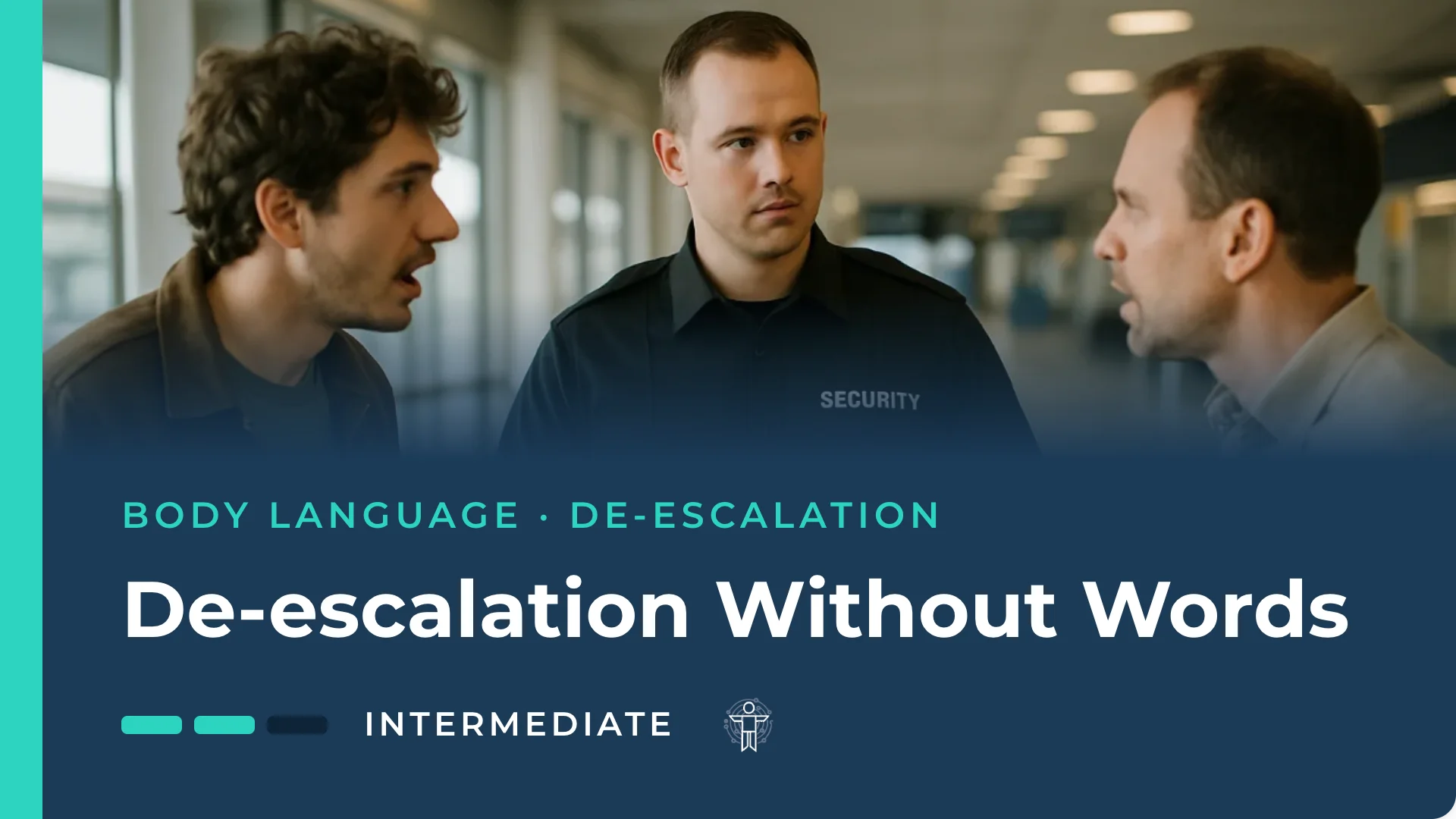
De-escalation Without Words: Read Tension Early and Lower the Temperature Safely
Build a practical, evidence-informed ability to notice rising tension, regulate your own non-verbal impact, and intervene before public-facing situations become confrontational. Across hospitality, retail, aviation, security, and public services, you will practise observation, baseline comparison, cluster reading, contextual judgement, and safe escalation—without treating body language as mind reading or a lie detector.
Choose how much support you want
Same price on this course as every other. The only decision here is the level of guidance.
self-paced in the Academy live with a trainer
Self study
ACADEMYLearn the method at your own pace, on any device.
- All video lessons and materials
- Self-paced, any device
- Exercises + downloadable tools and checklists
- Community access
- AI tutor
- Completion certificate
Cohort
ACADEMYLIVELearn the method, then practise it live with a small group.
- Everything in Self study
- 4 live online group sessions (60 min)
- Guided practice for this course
- AI tutor
- 60-day session recordings
- Guided tasks between sessions
- Small group — max 15
VIP
ACADEMYLIVEPractise it live — private coaching on your real situations.
- Everything in Cohort
- Unlimited live group sessions (60 min)
- 3 private 1:1 sessions with the founder
- Personalised feedback on your real situations
- Priority support
- Personalised action plan
Secure checkout powered by Stripe. Buying for a team of 5 or more? See team pricing
Continuing Professional Development
CPD certified by Open CPD
- Self Study
- 6.5 CPD hours
- Cohort — adds 4 live sessions
- 10.5 CPD hours
Open CPD Reg. ID 620113 · Self Study figure is our own estimate
How our CPD works →What you’ll cover
- →Read the Escalation: Physiology and Pre-Incident Signals
- →Spot the Deviation: Baselines in Queues and Crowds
- →Regulate the Room: Make Your Own Body the Intervention
- →Approach Without Triggering: The De-escalation Encounter
- →Adapt Under Pressure: Special Environments and Constraints
- →Know When Not to Engage: Intuition, Exit, and Escalation
What this course does not claim
Body-language marketing is full of myths. Here is what we deliberately won’t tell you.
- That one gesture “means” one thing, or reveals a lie.
- That you’ll read minds or “detect deception instantly”.
- Any “% of communication is non-verbal” figure.
What you get instead: baseline-and-cluster observation, read in context — noticing more and guessing less.
Course Curriculum
0Welcome to BodyLytics
Your guided introduction to the BodyLytics learning platform — discover interactive features, track your progress, and get the most out of your learning journey.
1.0Map How Arousal Appears in the BodyPreview
Learn to recognise observable patterns of physiological arousal without turning discomfort into a verdict about intent. Using Navarro’s comfort–discomfort framework, de Becker’s attention to pre-incident behaviour, and Ekman’s work on emotional leakage, you will practise separating what you can see from what you are tempted to conclude.
1.1Practise Observation Without Mind Reading
In this practice lesson, you will train yourself to separate what you can observe from what you merely infer. Using supermarket returns-desk scenarios, you will record visible actions, timing, changes, and context before considering several plausible explanations. The goal is disciplined observation: noticing discomfort or cognitive load without turning a cue into a verdict about anger, dishonesty, or danger.
1.2Cluster Signals Across a Workplace Interaction
In a municipal reception area, tension rarely announces itself through one dramatic gesture. You will practise combining baseline changes, behavioural clusters, and context before deciding whether to check in, monitor, or seek support. The activities move from recognising individual observations to making a proportionate, evidence-based assessment.
1.3Build a Context-First Observation Log
In this integration lesson, you will bring together the module’s core skills: noticing physiological arousal, comparing behaviour with a baseline, identifying clusters, accounting for context, regulating your own presence, and choosing a proportionate response. You will practise turning intuition into a disciplined observation log rather than treating it as proof of danger, deception, or intent.
1.4Module Test: Physiology and Pre-Incident Signals
This assessment consolidates Module 2: physiology, discomfort, cognitive load, pre-incident indicators, baseline comparison, clusters, context, and safe escalation decisions. You will be assessed on whether you can describe what you observe without turning a cue into a conclusion, generate alternative explanations, and choose a proportionate response in public-facing environments.
2.0Establish Individual and Group Baselines
Before you can recognise a meaningful deviation in a queue or crowd, you must first understand what ordinary behaviour looks like in that setting. This lesson introduces a disciplined baseline–deviation approach, combines individual observation with group-level pattern recognition, and applies Hall’s proxemics framework to a railway ticket queue.
2.1Compare Deviations Rather Than Personalities
In a department-store collection queue, the same visible behaviour can mean very different things depending on a person’s established pattern. You will practise separating deviation from baseline from stable personal or cultural style, then decide when a respectful check-in is proportionate and when observation should continue without intervention.
2.2Read Crowds as Moving Systems
Learn to observe queues and crowds as changing systems rather than collections of suspicious individuals. You will establish a local baseline, identify meaningful deviations and clusters, account for context, and choose a respectful information intervention that can lower tension without escalating it.
2.3Use the Four-Step Decision Gate
Bring the module together with a repeatable method for reading tension in queues and crowds without turning discomfort into a risk label. You will analyse a university service-centre queue, distinguish observation from interpretation, and choose proportionate responses: information, space, or supervisor support.
2.4Module Test: Baselines and Queue Deviations
This assessment brings together the core skills from Module 3: establishing a context-specific baseline, detecting meaningful deviations, recognising clusters rather than isolated gestures, and choosing a proportionate early response. You will be assessed on observation and judgment—not on guessing who is deceptive or dangerous. Complete the activities carefully, then review the explanations to identify where your reasoning is strong and where it needs refinement.
3.0Set a Stable, Non-Blocking Stance
Learn how your feet, shoulders, hands, angle, and position in space can reduce perceived threat during a tense encounter without becoming passive, theatrical, or controlling. Using a hotel reception dispute, you will examine why a stable stance supports both de-escalation and personal safety—and why body language should be treated as evidence to interpret, never as a guarantee of cooperation.
3.1Calibrate Distance and Approach Pace
In a tense service interaction, distance is not empty space: it is information. You will practise using culturally aware proxemics, a measured approach pace, and non-cornering positioning to reduce perceived threat while preserving operational control.
3.2Coordinate Hands, Objects, and Voice
Practise using visible hands, deliberate movement, neutral facial expression, and measured vocal delivery to reduce ambiguity during tense service interactions. You will apply these skills at a pharmacy counter while preserving the other person’s agency and avoiding manipulative performance.
3.3Rehearse Self-Regulation Under Pressure
This integration lesson brings together the module’s central skill: using your own regulated body to reduce threat, preserve dignity, and create room for a safer interaction. You will rehearse a pre-contact reset before approaching a visibly frustrated parcel-collection customer, revisit the module’s key terms, and build a personal regulation checklist you can use in real service environments.
3.4Module Test: Regulated Non-Verbal Presence
This practical assessment brings together the core skills from Module 4: regulating your own body, shaping distance and orientation, keeping your hands visible, controlling movement and vocal delivery, and recognising when safety takes priority over engagement. You will be assessed on application rather than memorisation. Several scenarios require you to distinguish a calm, proportionate intervention from behaviour that could appear threatening, intrusive, culturally inappropriate, or unsafe.
4.0Choose the Safest Approach Angle
Your first movement toward a tense person communicates before your words do. In this lesson, you will examine how approach angle, spatial distance, visibility, barriers, companions, and exit routes shape perceived threat—and how to select a proportionate, non-threatening position in a public setting.
4.1Open With Non-Threatening Engagement
Practise the first seconds of a tense encounter: regulate your presence, approach from a workable angle, acknowledge the difficulty, pause without crowding, and ask one simple operational question. You will apply the sequence in a train-station information booth without diagnosing the person, promising an outcome, or turning a service problem into a contest.
4.2Manage Space, Audience, and Attention
Learn to read the environment before approaching a tense service encounter, then reduce pressure without trapping, isolating, or publicly shaming the person.
4.3Run the Full Contact Protocol
This integration lesson brings together the complete de-escalation sequence: observe, establish a baseline, identify clusters and context, regulate yourself, approach without triggering, acknowledge, pause, offer proportionate options, and hand over safely. You will apply the protocol in a realistic city permit-office encounter where a refusal increases visible tension, then practise deciding when observation must become coordinated support.
4.4Module Test: The De-escalation Encounter
This capstone assessment evaluates whether you can conduct a safe, structured first contact in a tense frontline encounter. You will be assessed on observation without premature conclusions, regulated non-verbal presence, approach angle and distance, proportionate choices, support requests, disengagement, and handover. The assessment draws on pacing and rapport principles [Romilla Ready, pp.136–137], perceptual positions [Romilla Ready, pp.120–121], proxemics and seating research [The Definitive Book of Body Language, pp.330–335], and threat-management principles from Gavin de Becker [The Gift of Fear, pp.160–162, 214–215].
5.0De-escalate in an Aircraft Cabin
Aircraft cabins compress distance, limit exits, amplify audience effects, and remove many of the support options available on the ground. In this lesson, you will apply a structured observation method to a passenger whose behaviour may reflect rising anxiety, frustration, cognitive overload, or aggression—without diagnosing the person or treating one cue as proof. You will learn how positioning, visible hands, timing, aisle access, and discreet crew coordination can lower perceived threat while preserving operational safety.
5.1Stabilise a Check-In Desk Dispute
Practise reading and reducing tension during a busy airport check-in dispute. You will work with visible behavioural cues, counter positioning, a quieter side position, and simultaneous service to the wider queue—without treating any single movement as proof of intent.
5.2Handle a Late-Night Venue Threshold
A practical scenario lesson on reading tension at a music-venue entrance when re-entry is denied. You will apply positioning, audience management, early support escalation, and non-contact de-escalation while accounting for crowd density, noise, alcohol, and limited exit routes.
5.3Reduce Friction at a Service Counter
Integrate your observation, proxemics, regulated presence, approach protocol, contextual analysis, and safety judgment in a retail returns incident. You will examine how objects, surfaces, queue geometry, and colleague placement can restore predictability—while recognising when environmental design is not enough.
5.4Module Test: Special Environments
This capstone assessment tests whether you can transfer the baseline–deviation–cluster–context method into four operationally different environments: an aircraft cabin, an airport check-in desk, a late-night venue, and a service counter. You will be assessed on observation, regulated presence, non-threatening approach, proportionate intervention, and knowing when safety requires distance and support rather than engagement.
6.0Distinguish Unease From Evidence
Learn to respect intuition as an early attention signal without confusing it with proof. You will apply baseline, deviation, cluster, and context thinking to a hotel car-park scenario, documenting observable facts, checking proportionately, and choosing safety over accusation.
6.1Recognise the No-Engagement Threshold
In frontline work, professionalism does not mean staying in every conversation. This practice lesson helps you recognise when distance, support, and exit take priority over rapport-building—especially when threats, blocked routes, possible weapons, intoxication, stalking behaviour, or group dynamics make engagement unsafe.
6.2Execute Exit and Support Protocols
In a tense encounter, your safest contribution may be neither persuasion nor confrontation. This activity lesson turns early concern into a role-specific protocol: create distance, preserve an exit, involve support discreetly, protect bystanders, and record observable facts without escalating the situation.
6.3Integrate a Complete Safety Decision
In this capstone lesson, you will bring together the module’s central disciplines: observe without over-interpreting, notice clusters and deviations from baseline, regulate your own presence, decide whether engagement is safe, create distance and escape options, request support, and document facts afterward. You will work through a civic service hub scenario in which agitation, blocked space, incomplete information, and a gathering audience create pressure to act quickly. The goal is not to appear fearless or to “win” the interaction; it is to make a proportionate, defensible safety decision.
6.4Module Test: Safe Disengagement and Escalation
This demanding assessment brings together the module’s central safety skills: recognising observable changes without overclaiming, treating intuition as a prompt rather than proof, regulating your own presence, choosing proportionate disengagement, requesting support, and documenting behaviour accurately. You will work through realistic frontline situations involving service counters, aircraft cabins, late-night venues, and workplace encounters. The assessment rewards sound judgement—not dramatic intervention.
7.0Comprehensive Final Exam: De-escalation Without Words
This examination assesses whether you can apply the complete BodyLytics de-escalation method under uncertainty: observe physiology and behaviour, establish a baseline, identify meaningful deviations and clusters, account for context, regulate your own presence, manage space and approach, and choose proportionate support or disengagement. The exam rewards disciplined observation and safe decisions—not confident guesses about another person’s thoughts, character, or intent.
7.1Course evaluation
You have reached the end of De-escalation Without Words. This short evaluation invites you to assess the course’s relevance, clarity, realism, confidence-building value, and transfer to your workplace so future learning can be made more practical and effective.