

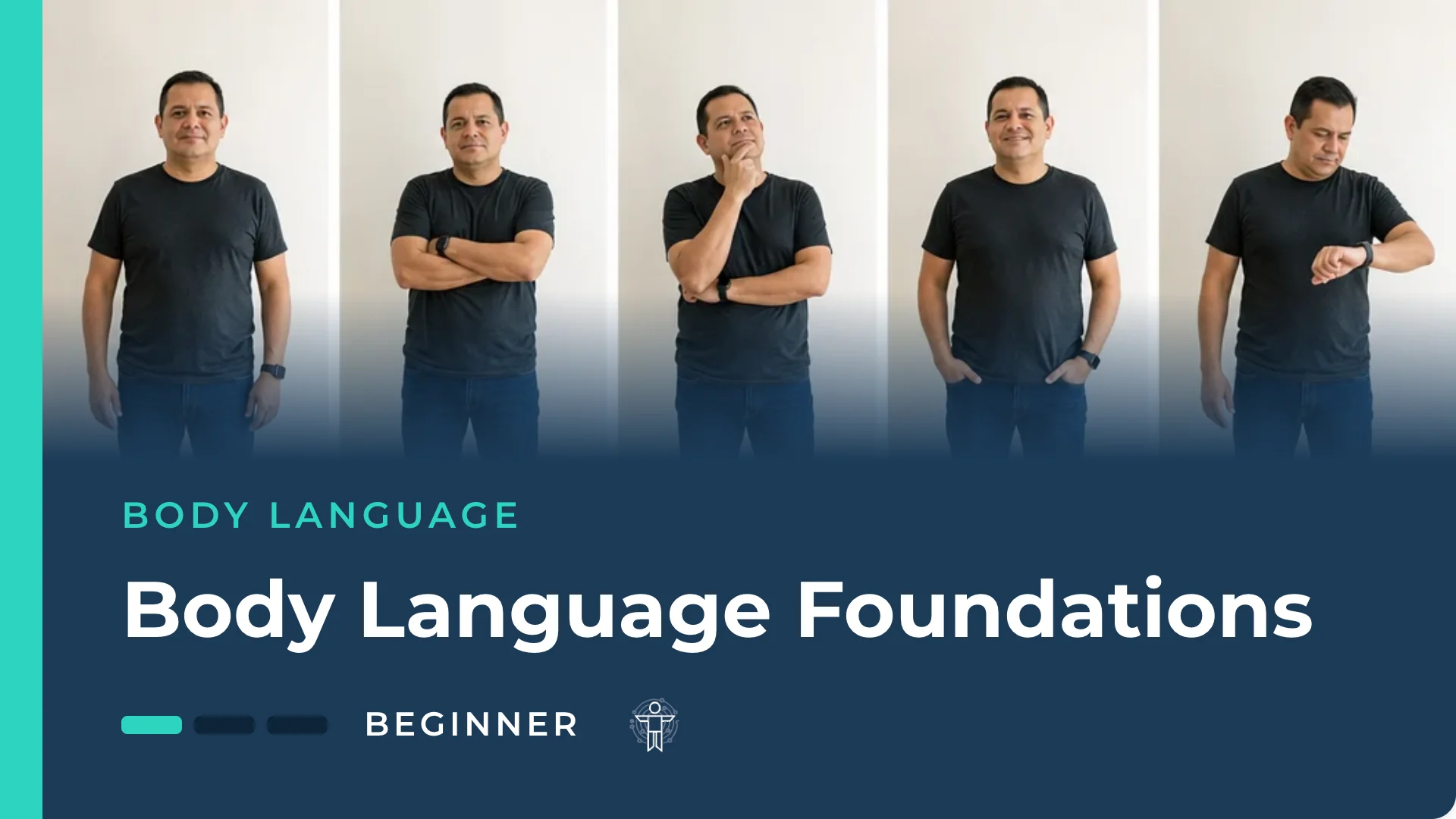
Body Language Foundations: Read Non-Verbal Communication with Evidence and Judgment
Build a disciplined, practical method for observing non-verbal behaviour without falling into mind-reading, lie-detection, or single-signal myths. Progress from careful observation and behavioural baselining to facial, postural, spatial, and cluster analysis in realistic professional situations, with honest attention to context and accuracy limits.
Choose how much support you want
Same price on this course as every other. The only decision here is the level of guidance.
self-paced in the Academy live with a trainer
Self study
ACADEMYLearn the method at your own pace, on any device.
- All video lessons and materials
- Self-paced, any device
- Exercises + downloadable tools and checklists
- Community access
- AI tutor
- Completion certificate
Cohort
ACADEMYLIVELearn the method, then practise it live with a small group.
- Everything in Self study
- 4 live online group sessions (60 min)
- Guided practice for this course
- AI tutor
- 60-day session recordings
- Guided tasks between sessions
- Small group — max 15
VIP
ACADEMYLIVEPractise it live — private coaching on your real situations.
- Everything in Cohort
- Unlimited live group sessions (60 min)
- 3 private 1:1 sessions with the founder
- Personalised feedback on your real situations
- Priority support
- Personalised action plan
Secure checkout powered by Stripe. Buying for a team of 5 or more? See team pricing
Continuing Professional Development
CPD certified by Open CPD
- Self Study
- 7.5 CPD hours
- Cohort — adds 4 live sessions
- 11.5 CPD hours
Open CPD Reg. ID 620113 · Self Study figure is our own estimate
How our CPD works →What you’ll cover
- →See First, Interpret Second
- →Establish the Behavioural Baseline
- →Read the Face and Eyes with Humility
- →Read Hands, Posture, Feet, and Orientation
- →Apply Space, Distance, and Positioning
- →Analyse Clusters and Context
- →Integrate the Professional Reading Method
What this course does not claim
Body-language marketing is full of myths. Here is what we deliberately won’t tell you.
- That one gesture “means” one thing, or reveals a lie.
- That you’ll read minds or “detect deception instantly”.
- Any “% of communication is non-verbal” figure.
What you get instead: baseline-and-cluster observation, read in context — noticing more and guessing less.
Course Curriculum
0Welcome to BodyLytics
Your guided introduction to the BodyLytics learning platform — discover interactive features, track your progress, and get the most out of your learning journey.
1.0Distinguish Observation from InterpretationPreview
Before you can interpret non-verbal behaviour responsibly, you need to separate what your senses register from the meaning your mind assigns. In this lesson, you will practise describing behaviour precisely, recognise how first impressions and assumptions distort professional judgment, and apply an evidence-informed observation method to a realistic Brussels workplace scenario.
1.1Practise Neutral Behaviour Notes
Learn to convert interpretations into precise, observable notes during a realistic supplier negotiation. You will practise separating what a procurement manager visibly does from the explanations you might be tempted to attach to it, then use clusters, context, and follow-up questions to improve your judgment.
1.2Recognise the First-Impression Trap
Learn why trustworthiness and competence judgments can form almost immediately, how those judgments become anchors, and how to replace confidence with disciplined observation. You will practise separating visible evidence from interpretation in professional and European workplace contexts.
1.3Reset a Professional Judgment
In this activity lesson, you will practise separating observable behaviour from interpretation when a candidate’s opening appears unusually quiet. You will use a structured pause, generate alternative hypotheses, and record what evidence you would gather before making a professional judgment. The focus is not on becoming more certain from limited information; it is on becoming more accurate, fair, and evidence-informed.
1.4Module Test: Observation Before Interpretation
This assessment consolidates Module 2 by asking you to separate visible behaviour from interpretation, account for baseline and context, recognise the influence of first impressions, and formulate ethical follow-up questions. You will work through a realistic workplace interaction and complete several application-based activities covering the full observation-before-interpretation method.
2.0Define a Personal Behavioural Baseline
Learn how to observe ordinary behaviour during low-stakes conversation so that later changes can be interpreted carefully, ethically, and in context. You will practise separating what you can see from what you think it means, while accounting for personality, culture, disability, habit, and the pressure of the interaction itself.
2.1Calibrate During Low-Stakes Conversation
Before you interpret a behavioural change, you need a trustworthy comparison point. In this practice lesson, you will calibrate your observations during an ordinary café conversation, recording a partner’s typical patterns without labelling, diagnosing, or announcing conclusions. You will then distinguish genuine deviations from normal variation caused by personality, culture, stress, habit, or accessibility needs.
2.2Track Topic-Linked Deviations
Learn to connect a visible behavioural change to the question, event, or environmental shift that preceded it. You will practise separating an observable deviation from the story you may be tempted to tell about it, then use clusters and respectful follow-up questions to investigate without treating body language as proof of deception.
2.3Test Alternative Explanations
Learn to investigate behavioural deviations without rushing to conclusions. You will practise using context, culture, accessibility, environment, and task difficulty to test competing explanations before deciding what to ask next.
2.4Module Test: Behavioural Baselining
This assessment brings together the core skills from Module 3: observing ordinary behaviour, identifying meaningful changes, separating observation from interpretation, considering cultural and situational context, and asking neutral follow-up questions. You will work through realistic professional scenarios rather than identify supposedly universal “tells.” A strong result means you can describe what changed, explain what it might mean without overstating certainty, and choose a respectful next step.
3.0Map Facial Movement Before Emotion Labels
Learn to observe facial movement with anatomical precision before assigning emotional meaning. You will use FACS-informed description, baseline comparison, and contextual reasoning to analyse a sales engineer’s reactions without turning a facial cue into a verdict about attitude, intent, or deception.
3.1Code Visible Facial Changes
In this practice lesson, you will train yourself to describe facial behaviour before interpreting it. Using a customer-success call with a Danish client, you will record brow movement, eye narrowing, lip compression, smile timing, and asymmetry as observable events—then consider several possible explanations without labelling the client’s private thoughts or judging deception.
3.2Recognise Micro-Expression Limits
Brief facial changes can be informative, but they are not lie detectors or windows into private thoughts. In this lesson, you will learn to describe micro-expressions precisely, distinguish observation from interpretation, and assess a fleeting lip press in a French board presentation without overclaiming what it means.
3.3Compare Face, Voice, and Context
Learn to compare facial, vocal, and contextual evidence without treating incongruence as proof of deception. This integration lesson develops careful observation, baseline comparison, cognitive-load awareness, and ethical professional judgment.
3.4Module Test: Facial and Eye Observation
This assessment brings together the module’s core skills: describing facial and eye behaviour precisely, separating observation from interpretation, recognising the limits of micro-expression and eye-based inference, and choosing a responsible follow-up question. You will work through realistic professional scenarios rather than trying to label people or declare who is truthful. The standard is disciplined observation: notice change, consider context, compare with a baseline, and use conversation to test your interpretation.
4.0Observe Posture and Torso Direction
Learn to read uprightness, leaning, body angle, and torso orientation as contextual signals of relative engagement, withdrawal, comfort, or cognitive load. You will practise separating observable behaviour from interpretation, establishing a baseline, and checking environmental explanations before drawing conclusions.
4.1Practise Whole-Body Mapping
Learn to track observable changes across the head, torso, arms, hands, and legs during a workplace conversation. Practise comparing a compliance officer’s baseline with their response to a complex regulatory question while separating evidence from interpretation.
4.2Identify Pacifying and Load-Management Behaviours
Learn to recognise self-soothing and cognitive-load behaviours as changes in comfort, attention, or processing demand—not as proof of dishonesty. You will examine pacifying cues in context, compare them with a person’s baseline, and practise forming careful, ethical follow-up questions.
4.3Use Feet and Orientation as Conversation Data
Learn to observe feet, weight shifts, body angles, and movement direction as context-sensitive conversation data. Practise separating visible behaviour from interpretation, combining lower-body cues with posture and hands, and testing observations with neutral questions rather than premature conclusions.
4.4Module Test: Whole-Body Signals
This assessment brings together the module’s core skill: observing posture, hands, feet, torso orientation, and pacifying behaviours as a connected pattern rather than treating one gesture as proof of an emotion or intention. You will analyse a workplace scenario, distinguish observation from interpretation, consider alternative explanations, and choose an ethical follow-up response. The assessment is grounded in Navarro’s baseline-and-cluster method, Morris’s discussion of self-contact, and evidence-informed caution about reading non-verbal behaviour in professional settings.
5.0Describe Proxemic Zones in Context
Learn Edward T. Hall’s framework for describing intimate, personal, social, and public space, then apply it cautiously in a multicultural professional setting.
5.1Practise Distance Calibration
In this hands-on lesson, you will practise adjusting distance, orientation, seating, and barriers during a professional consultation. You will work with proxemic zones as flexible starting points—not universal rules—and learn to observe the other person’s response before deciding whether to move closer, create more space, or change position.
5.2Analyse Seating, Barriers, and Territory
Learn how furniture, objects, entrances, and seating arrangements shape access, status, defensiveness, and participation in professional meetings. You will apply evidence-informed observation to redesign a cross-functional meeting in a London technology firm without treating any position or gesture as proof of attitude.
5.3Design a Comfortable Professional Layout
Integrate baseline observation, proxemics, seating, territory, orientation, and ethical interpretation into a practical plan for a customer mediation room in Madrid. You will practise designing a layout that protects privacy, preserves dignity, accommodates cultural and accessibility needs, and supports cooperation without treating space as a universal formula.
5.4Module Test: Space and Positioning
This assessment brings together the module’s core skills: recognising territorial behaviour, interpreting seating and orientation, adapting distance across professional contexts, and checking comfort without treating body language as proof of intent. You will analyse realistic workplace situations, distinguish observation from interpretation, and choose responses that preserve dignity, safety, and cooperation.
6.0Build a Multi-Channel Behavioural Cluster
Learn how to move beyond isolated gestures by combining changes across the face, voice, posture, hands, feet, and interpersonal distance. You will practise identifying clusters that are linked to a specific event while keeping your conclusions focused on comfort, discomfort, or cognitive load—not unsupported claims of deception.
6.1Practise Cluster-Based Follow-Up
In this practice lesson, you will analyse a simulated renewable-energy negotiation using a disciplined sequence: establish the baseline, identify deviations, assemble clusters, account for context, and formulate a neutral follow-up question. You will practise separating observable behaviour from interpretation so that discomfort becomes a prompt for exploration—not a verdict about deception.
6.2Debunk Single-Signal and Lie-Detection Myths
Learn why isolated gestures cannot prove deception, how context changes the meaning of visible behaviour, and how to replace suspicion with disciplined observation and respectful follow-up. Using Navarro’s comfort–discomfort framework, you will examine crossed arms, gaze aversion, pacifying gestures, and cognitive load without treating any one signal as a verdict.
6.3Weigh Context Before Deciding
Learn to turn a cluster of non-verbal observations into a careful, evidence-informed decision. You will use a decision matrix to assess a buyer’s reaction to a pricing change without confusing discomfort with deception or treating one gesture as proof.
6.4Module Test: Clusters, Context, and Myths
This assessment brings together the observation method developed throughout Module 7. You will analyse a complex European workplace case, separate observable behaviour from interpretation, establish a baseline, identify topic-linked clusters, reject unsupported deception claims, and formulate a proportionate follow-up plan. The goal is not to become a human lie detector; it is to make disciplined, ethical judgements under uncertainty.
7.0Run the Observe-to-Question Workflow
Practise a complete, ethical observation workflow in a difficult performance conversation: observe without labelling, establish a behavioural baseline, identify clustered changes, weigh context, and use respectful questions rather than conclusions. You will work through a Copenhagen workplace scenario where non-verbal information helps you decide what to explore—not what to believe.
7.1Evaluate Congruence Without Overclaiming
Learn to compare spoken words with tone, facial behaviour, posture, gestures, and timing without turning a mismatch into a verdict. Using a Dublin restructuring announcement as a working scenario, you will practise distinguishing observation from interpretation, identifying clusters of change, and choosing respectful clarification questions.
7.2Conduct a Cross-Cultural Case Review
In this practical case review, you will analyse a multinational sales meeting involving French, Finnish, and Italian participants. You will separate observable behaviour from interpretation, establish within-meeting baselines, account for proxemic and gesture variation, and identify topic-linked clusters without turning cultural style into evidence of deception.
7.3Create Your Professional Observation Checklist
Bring the module together by building a practical, ethical observation system for first meetings with public-sector clients in Brussels. You will integrate observation, baseline calibration, clustered deviations, context, uncertainty language, and respectful follow-up into a checklist you can actually use.
7.4Module Test: Integrated Professional Reading
This capstone assessment brings together the complete professional reading method: observable behaviour, baseline, deviations, clusters, context, proxemics, and proportionate follow-up. You will analyse realistic workplace situations and demonstrate that non-verbal evidence should guide better questions—not become a verdict about another person’s thoughts, character, or honesty.
8.0Final Exam: Evidence-Informed Non-Verbal Communication
Apply the complete Body Language Foundations method to a demanding European workplace negotiation. You will separate observation from interpretation, establish a personal baseline, analyse clusters in context, account for culture and personal space, choose proportionate verbal follow-up, and state the ethical limits of your conclusions.
8.1Course Evaluation
Review the evidence-based observation method, practise applying it responsibly, and share feedback that will help improve Body Language Foundations.